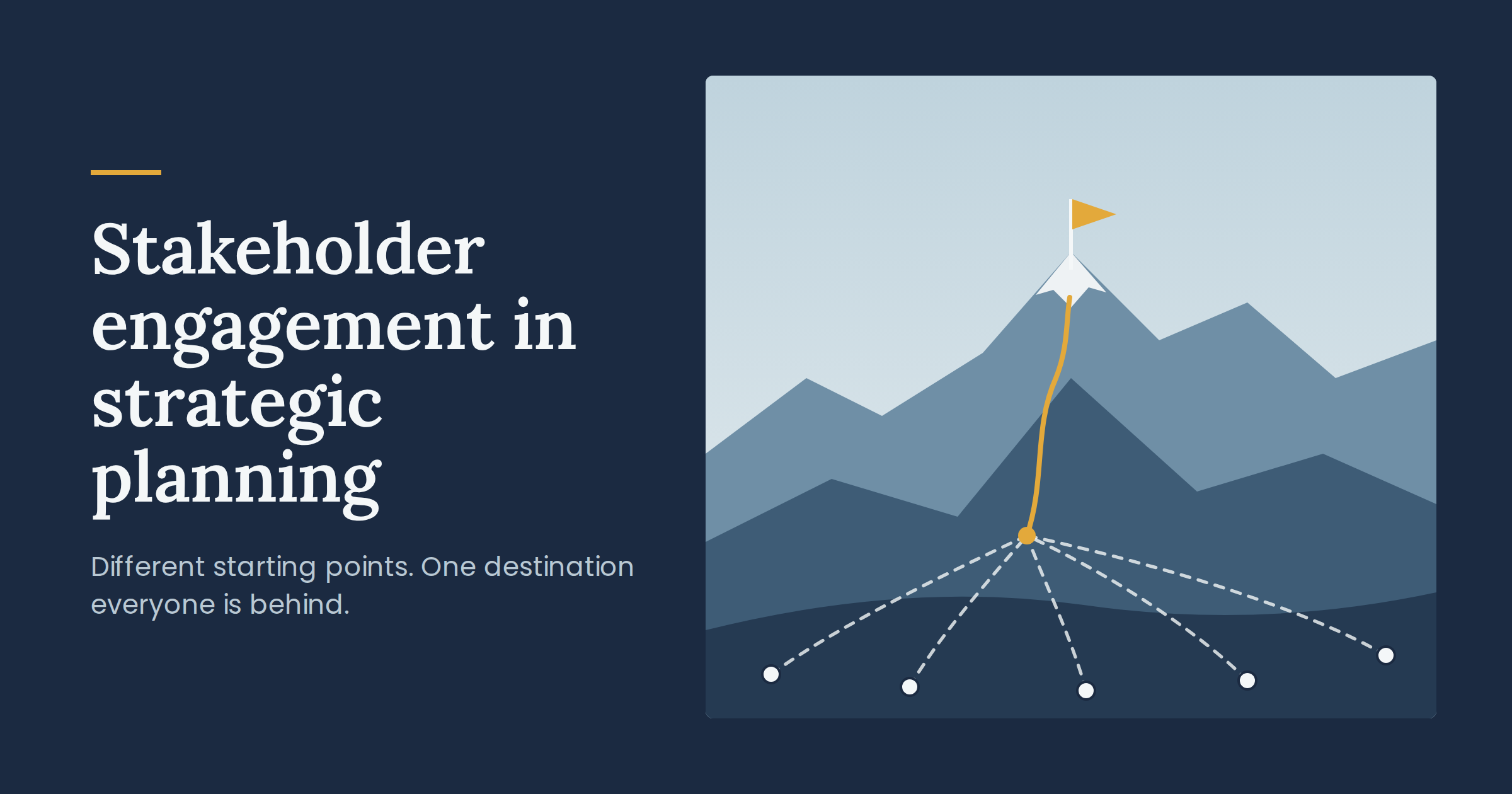
In strategic planning, stakeholder engagement means involving the people who will carry out, approve, fund, or depend on the plan, before it's final and often throughout execution. Some of them sit inside the organization: the board, executives, managers, and staff. Others sit outside it: funders, partners, affiliates, members, and other organizations working on the same problem.
Most advice treats engagement as a discovery exercise, a way to collect ideas and uncover hidden problems. That's not where the value is. Engagement builds the alignment a plan needs to survive execution: a shared understanding of where everyone is going, and enough buy-in that people want it to work.
For the fundamentals of identifying and mapping stakeholders, start with What Is Stakeholder Engagement and Why Is It Important for Strategic Planning. This post covers how engagement differs depending on who you're engaging, and how to keep it going once the plan is approved.
Alignment is what you're buying
A strategic plan works when everyone is building toward the same destination. That's harder than it sounds, because a plan written by six people in a conference room gets interpreted by hundreds, sometimes across several organizations.
One region's "customer focus" is another region's "service levels." A funder's "outcomes" is a frontline team's "caseload." Nobody is trying to derail anything. Each group has built its own version of the plan, and the differences compound quietly for years.
Engagement surfaces those interpretations before the plan is finalized, while you can still fix them with language instead of a year of rework.
Where engagement happens
Engagement looks different depending on who you're aligning. Most strategic plans involve more than one of these at once.
Across levels. The board, executives, senior managers, and frontline staff read the same plan through different lenses. The board sees mandate and risk. Executives see priorities and resources. Managers, who spend most of their time in operations, see what changes in their week. A plan that only makes sense at the top gets lost on the way down. The organizational strategic planning post covers this in more depth.
Across functions. Departments, regions, and business units use the same strategy terms for different work. Engagement here is about agreeing on what the words mean, and on which trade-offs between units leadership is willing to make.
Across organizations. This is the hardest and most overlooked kind. A health organization might need to align with funders, partner agencies, community organizations, and member groups, each with its own board, staff, and priorities. Nobody reports to anybody. The plan works only if those organizations choose to support it, so engagement is about hearing what each needs and building a plan they can see themselves in.
Where governance requires it. First Nations governments, cooperatives, associations, and many nonprofits have groups with formal authority over strategy. A plan that needs council, board, or membership approval has to be built and documented differently from one that only needs executive sign-off. Sequencing matters: sometimes you meet with groups separately first, so positions can shift without anyone losing face in front of a full room.
Triangulating the truth
Each stakeholder group sees part of the picture. A funder sees outcomes across its whole portfolio. A partner agency sees where handoffs break down. Frontline staff see what happens to the people the plan is meant to serve. The board sees risk and obligation. None of them is wrong, and none of them has the whole story.
The work is putting those views side by side. Where they agree, you've found something solid to build on, and they usually agree more than anyone expected. Where they differ, you've found the conversation the plan has to resolve. The goal is a common vision that every group recognizes and can see itself represented in, even if no single group would have written it that way.
Engagement doesn't find "secrets"
Leaders often expect engagement to reveal something shocking. That almost never happens. Most concerns have been raised before, often repeatedly, by people who have watched nothing come of it.
That's the real problem. It isn't that leadership doesn't know. It's two groups pulling against each other, one raising the same issues year after year, the other unable or unwilling to address them, and nobody closing the loop. People will tolerate being ignored for a while. Eventually they stop raising things and quietly stop supporting the plan.
Engagement changes the terms. You're saying: we want to hear this, here's what we're doing about it, and here's the sequence. You won't agree with everyone on everything. What people need to see is that some of it is being worked on, in some form, on a timeline they can point to.
Hearing it in their words
Good engagement uses three methods, each doing something the others can't.
An open-ended, anonymized survey gets you what people won't say with their name on it. Asked the same question, everyone answers the question rather than reacting to who's asking.
Interviews let you probe. Someone says the handoff between teams is broken, and you can spend ten minutes finding out what that means and where it breaks.
Group sessions do something neither can. When people hear others in the same seat describe the same problem, they find out whether it's just them or everybody. That changes how they see it, and it aligns stakeholders with each other rather than only with leadership. Groups I've worked with have said the peer conversation was the most valuable part of the process, and it's the part most engagement plans leave out.
What you end up with is their language, not your summary of it. That matters, because the gap between what leadership assumes a group needs and what they'd say themselves is where most plans go wrong. You can build for where people are rather than where you think they are, and when you explain a decision later, you're using words they recognize.
Support versus execute
There's a difference between people who execute a plan and people who support it. A plan handed down gets executed: people do what's assigned and stop there. A plan people helped shape gets supported. They make judgment calls in its favor when nobody is watching, and they defend it to their own teams when it's questioned. Most plans don't stall for lack of execution. They stall because nobody outside the leadership team is standing behind them.
Some stakeholders will never execute anything, and their support still decides whether the plan works. An organization with affiliates exists in large part to serve them. The affiliates don't carry out the plan, but if they see their priorities reflected, they promote the organization, stay involved, and treat its direction as their own. If they don't, the plan can be executed perfectly and still lose the people it was built for. The same is true of funders and partners.
Before you design the engagement, sort your stakeholders by what you need from them. Executors need to understand what changes in their work and why. Supporters need to see their needs in the plan and trust that they're being worked on. Many groups need both.
Buy-in and change resistance
Every strategic plan creates resistance, including from people the plan benefits. That's normal, and it usually means someone is thinking seriously about what the change means for them.
Engagement doesn't eliminate resistance, but it changes what you're working against. Someone who helped shape the plan is arguing about how to get somewhere they already agreed to go. Someone who received it as an announcement is arguing about whether to go at all.
People want to be part of the solution when they were part of creating it. That's most of what buy-in is.
Real disagreement versus miscommunication
Much of the work is sorting disagreements into two kinds, because each needs a different fix.
Some are real trade-offs. Two business units want the same capital, or two partner organizations want the plan to lead with different priorities. Leadership has to make these calls and explain them clearly, including what's being given up.
Others are misunderstandings that resolve once each side hears how the other is thinking. Treating a misunderstanding as a real conflict wastes a day of the session. Treating a real conflict as a misunderstanding produces a plan that breaks under pressure, because nobody made the call.
A third-party facilitator helps here, especially across organizations. The room focuses on the content instead of the history between the people in it.
How much up-front engagement is enough
For many organizations, one well-run round is all the plan needs. Before the leadership team or board starts planning, hold a listening session with each of your four or five key stakeholder groups. The findings go into a report that becomes an input to the planning process, so the plan is built around what those groups need rather than what leadership assumes they need.
That's enough for most nonprofits, and for companies where outside groups inform the plan but don't decide whether it succeeds.
When the plan is done, send each group a short note on what you heard and what the plan does with it. It isn't a second consultation. It's an email or five minutes at their next meeting, and it's what keeps a listening session from becoming one more request that went nowhere.
For a company with several layers of management, the internal baseline looks like this:
- Interviews with each senior leader, plus a pre-planning survey that takes about an hour of their time
- A two-hour listening session with your top 20 to 30 managers
- A cascade plan with two-way communication for everyone else
When the plan depends on other organizations, add listening sessions with each key funder, partner, or affiliate group. For governance-driven organizations, build the approval sequence into the timeline from the start.
This adds a month or two before the first planning session. It usually saves time overall, because you won't be rebuilding the plan six months later after learning a key group never supported it.
Engagement is a cycle, not a phase
When your plan depends on groups you don't control, one round isn't enough. Too often the plan gets approved, the input gets filed, and the groups who contributed hear nothing for three years.
Doing it properly has three parts, and only the first happens before the plan is final.
Validate the draft. Take it back to the groups you heard from and show them where their concerns landed and where they didn't, and why. Being told your concern was considered and deprioritized, with a reason, lands very differently from silence. This is the first fix in Why Strategic Plans Fail: 8 Reasons Execution Stalls, and the one most organizations skip.
Cascade it. Each group needs to hear what the plan means for them specifically, with a way to respond. A plan announced is not a plan communicated.
Build a recurring touchpoint. Add stakeholder engagement to your execution cadence the way you'd add a quarterly review. Depth should follow interest and influence: the groups whose support the plan depends on most get the deepest engagement. Once a year is a reasonable floor, though over a three-year plan that's only three conversations. Twice a year doubles it. Some relationships warrant quarterly, particularly if you're measuring satisfaction.
The format can vary as much as the frequency. Some options organizations use:
- An annual stakeholder summit that puts partners, funders, and affiliates in one room
- Quarterly roundtables of two to three hours, run as a World Café so you're drawing from the room instead of presenting to it
- Monthly or quarterly all-hands meetings of 90 minutes to two hours for internal groups
- Interviews run by a facilitator or researcher, when you need candid answers gathered systematically
- Short satisfaction surveys between the larger moments
- Informal time: coffee or breakfast at your location, a game, a round of golf
The informal options are often where the most honest conversations happen. They don't need to be lavish. They need to be intentional.
There's no prescriptive program. You build one around your stakeholders and what you need from them. Two cautions apply to all of it. Engagement done as a checkbox is visible as one, and it's worse than not asking. And asking repeatedly without showing anything in return draws down the goodwill you have with a group. The exchange has to be worth their time as well as yours.
If a stakeholder group has been ignored long enough that they've stopped engaging, you're not running a consultation, you're rebuilding a relationship. That takes longer than a planning cycle, and it's usually the group whose buy-in you need most for whatever comes next.
Where to start
Strategic planning is the natural place to build the first version of your stakeholder engagement program. You're already asking every group where the organization should go, so you have a reason to reach them and something to bring back.
Once the plan is approved, the program moves into your communication planning and your execution cadence: who you're engaging, how deeply, how often, and what they get in return. If your organization depends on stakeholders staying informed and behind what you're doing, that's where it has to live.

Frequently asked questions
What is the purpose of stakeholder engagement in strategic planning?
To build alignment and buy-in, and keep it through execution. It gives the groups who will execute, approve, fund, or depend on the plan a shared understanding of where things are going, and it lets leadership understand what each group needs in its own words.
Who should be involved in stakeholder engagement?
Anyone whose support or effort the plan depends on. Internally, that means multiple levels and functions, not just the executive team. Externally, it can include funders, partners, affiliates, members, and other organizations working on the same issue.
How is engaging external stakeholders different from internal ones?
Internal stakeholders can be directed; external ones have to choose to support the plan. Engagement with funders, partners, and affiliates focuses on understanding what each needs and showing where the plan delivers it.
What methods work best for stakeholder engagement?
A combination. Anonymized open-ended surveys surface what people won't say publicly, interviews allow follow-up questions, and group sessions let people hear from others in the same role. Each catches something the others miss.
How often should you engage stakeholders during a strategic plan?
It depends on how much the plan relies on groups you don't control. For many organizations, one round of listening sessions before planning is enough. When funders, partners, or affiliates are critical to the plan, engage them at least once a year, and more often for the groups it depends on most.
What's the difference between stakeholders who execute and those who support?
Executors carry out the plan, so they need clarity on what changes in their work. Supporters, such as funders, partners, or affiliates, may never execute anything, but the plan depends on their backing. They need to see their priorities reflected in it.
Does engaging stakeholders mean everyone gets a vote?
No. Leadership still decides. Engagement makes sure those decisions account for what the key groups will support, and that people can see where their input landed, including when it didn't change anything.
How does stakeholder engagement reduce resistance to change?
People who helped shape a plan argue about how to reach a destination they've agreed on. People handed a finished plan argue about whether to go. Engagement doesn't remove resistance, but it moves the argument to firmer ground.
Does stakeholder engagement make strategic planning take longer?
It adds one to two months before the first session, more when several organizations are involved. It often shortens the total timeline, because the plan doesn't need reworking after it meets resistance.
If you've made it to the bottom of this post, you're probably one of those organizations. I'm happy to walk through what a stakeholder engagement program could look like alongside your next plan. Book a conversation. If you'd rather start internally, the One Destination Alignment Scorecard is a good first step.